If You Choose
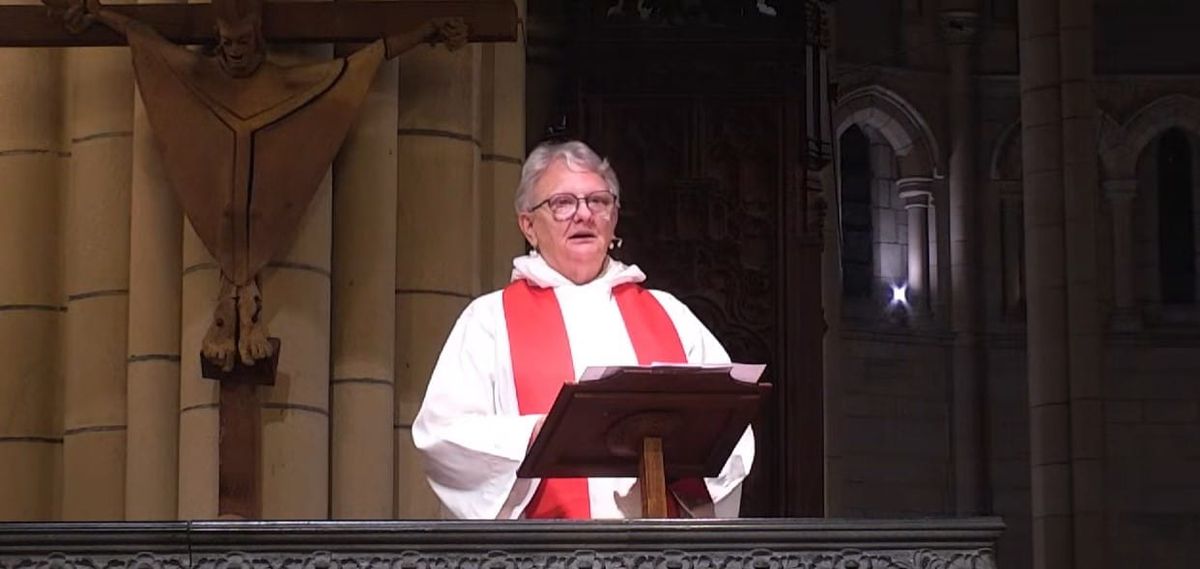
A sermon by the Rev'd Dr Elizabeth Smith for Synod Eucharist Diocese of Brisbane 25th June 2026. (2 Kings 24.8-17 Psalm 137.1-6 Matthew 8.1-4)
Did the preacher choose that Old Testament reading and the psalm especially for our Synod, I hear you ask? With all that besieging and famine, all that fleeing and scattering and deserting and defecting and capturing and slaughtering and burning and being carried off to weep by the rivers of Babylon? Is that what we have to look forward to this weekend? Is the preacher telling us we’re going into exile?
No, and no, my brothers and sisters; I did not choose the readings tonight; the lectionary did. And no, we are neither in exile nor are we heading there; although, like the exiles, perhaps we do often often feel like we are living in a strange land, where it’s really tricky to sing the Lord’s song.
Let me speak to that first.
We are not in exile, not like the people in the story from the Bible.
Admittedly some of us here are migrants or refugees, and there have been struggles and losses and trauma to get us here. If that’s you, yes, you are literally a long way from what your heart probably still thinks of as “home,” even while you’re putting down roots in this new and often confusing place.
Many more of us are the children and grandchildren and great-grandchildren of migrants, but this is the only land we’ve ever called “home.”
And some of you are First Peoples, Aboriginal and Torres Strait Islander people. Your story of “home” here goes back not hundreds but tens of thousands of years; and some of that story is about other people coming here recently, as uninvited and disruptive settlers. If that’s you, perhaps you often have times when you’ve been made to feel like an outsider in your own and your ancestors’ home.
But whoever we are, we are not in exile. Whoever we are, 21st century Australia is not Babylon. It is a strange land, yes; it is conflicted, and imperfect, and hard to navigate, and it is constantly changing. But it’s not Babylon. None of us is in exile.
Exiles look back with nostalgia. Exiles think the answer to “How can we sing the Lord’s song in a strange land?” is simply: “Stupid question. We can’t sing here. We’ve lost our voice, we don’t think God’s listening, we don’t have anything worth saying, and nobody here really wants to listen to us anyway.” That’s exile thinking, and we are not exiles. We’re not in enemy country. Nobody’s stopping us from practising our faith. There’s no going back to another time, another idealised, romanticised place when being an Australian was easy, or being an Anglican was a walk in the park. We don’t look back.
Instead, we look forward with hope. Not the hope of rebuilding what we think we used to have. We hope to grow into something new, and here, and now. To grow into a better Australian society together, an Australia with dignity and justice and respect for everyone who lives here. To grow into an Anglican Church that lives lighter, not living off our inherited privileges. A Church not living off the dregs of the respect we used to take for granted, and not living defensively under the shadow of the shame of our horrible mistakes either.
Instead, we want to grow into an Anglican Church that lives lighter, and with agility, and suppleness, and the ability to improvise. To grow into an Anglican Church that is still an institution – we’ll always have a lot of the institution about us, and there are good things about that, including longevity, and accountability – but an institution that doesn’t take itself too seriously, an institution that doesn’t dig bunkers. An institution that does hoist some sails to the mast, so it can go where the wind of the Spirit blows.
Imagine us growing into a Church that can laugh at itself, a Church with cheerful humility! Imagine a Church that spreads light-heartedness around, with non-anxious generosity! A Church that realises that of course we can sing the Lord’s song in this strange land, and sing it not like a dirge or a drone, but like a dance tune!
So no, I did not choose the Old Testament reading; but perhaps there is some value in reading about that long-ago, disastrous defeat and depressing exile, to remind us we are facing a different and more hopeful scenario here and now.
I didn’t choose the Gospel eading either; and Jesus healing the leper is not directly relevant to Synod. But it can also tell us something about your life together in Christ as the Diocese of Brisbane, the Anglican Church in Southern Queensland, as your Synod begins.
Synod always includes prayer: tonight at this Eucharist, and at various times during the meeting. Synod is governance and compliance. Synod is receiving reports, financial and budget reviews, governance checks, and hearing from all the great and small entitiies that admit to being Anglican somewhere on their website. Synod is carefully phrased legislation, and it’s mostly courteous and occasionally adversarial debate about things the rest of society might occasionally have an interest in. Synod is electing the people who will represent the Diocese to itself and to the national Church for the next few years. But all that business, both stuffy and stimulating, depending on your mastery of standing orders and your skill in debate, all that necessary business does not on its own a Synod make. Synod is also made by prayer.
At Synod, we also check the settings on our collective spiritual health. We want to be the spiritually healthiest organisation we can be. Spiritual health includes transparency, diligent record-keeping, and accountability. The spiritual health of an organisation, just like the spiritual health of an individual, also includes painful honesty about our shortcomings and our sorrows. Spiritual health includes being whole-heartedly thankful and joyful about our achievements and our blessings, about all the abundance that God is giving us. And at the foundation of everything we are as both an organisation, an institution, and as the Body of Christ, at the foundation of everything is prayer.
We pray because we are small, and God is not. God is vast: vast in love and judgement and forgiveness and healing. We pray because we are limited, and Jesus is not. Jesus Christ is alive, and he is all about about abundance and far horizons and resurrection power. We pray because we are timid, and the Holy Spirit is not. The Spirit is brave, outrageously bold, a wild risk-taker with nothing to lose and everything to give. We pray because the Trinity is holy and glorious and eternal and, well, God. So here we are, ready to love God through Synod, and to let God love us, for the sake of our spiritual health.
Prayer has many permutations. Praise, thanksgiving, lament, confession, blessing, dedication – all these are good, and we can find them all in their proper places in tonight’s Eucharist, which is the ultimate Christian prayer. But petition, asking God for help, petition is also core prayer business.
And we know that God is always responding to our most specific requests. The gospel stories are full of such intense requests, often for healing. Remember the mother who asks Jesus to cast the demon out of her daughter? Remember the father who says there’s a spirit that stops his son from speaking, and dashes him to the ground and into the fire? Remember the father whose little daughter is at the point of death? Remember the Roman centurion who says, “My beloved servant is paralysed, in terrible distress”?
Not all the requests to Jesus, not all the prayers, are verbalised. Sometimes the actions do the asking. Remember the people who cut through the roof of the house and dangle their paralysed friend through the ceiling? With Jesus, asking is always OK, and there’s no rules about the right or wrong way to ask.
As a church, we Anglicans have a good track record for praying for the world, and for people in need. We’re good at bringing the people we care about to God for help.
What we’re perhaps not so good at is asking for God’s help for ourselves. The people in the Gospels are not so shy. They are not sitting there feeling miserable, saying “There’s always someone worse off than me.” They are on their feet and asking. Remember the woman who’s been bleeding for 12 years, who grabs Jesus’ clothes in the middle of the crowd? Remember the blind man in Mark’s gospel, who shouts and Jesus, and when Jesus asks him, “What do you want me to do for you?” he says: “Lord, I want to see again.” And, of course, the leper in today’s story. He knows what he wants, and he’s not backward in asking for it: “Lord, if you choose, you can make me clean.” He wants to be clean, which means being reintegrated into his community. He wants to be set free from all the physical and social and spiritual constraints of his disability. He knows what he wants, and he asks for it.
So do let’s keep praying for other people; but let’s also get serious, about what we really want God to do for us, individually and collectively. What are we game to ask Jesus to do for us?
We’re probably not going to ask him for stuff, like Janis Joplin did in the 1960s classic, “Lord, won’t you buy me a Mercedes Benz.” Great song, lousy prayer. Stuff, Jesus would immediately remind us, is more the problem than the solution for our troubles. But maybe…
Lord, if you choose, you can make us extraordinarily good at communicating the Good News to Australian society.
Lord, if you choose, you can make us magnificently hospitable to newcomers and strangers.
Lord, if you choose, you can make our schools an exceptionally good place for hearing about Jesus.
Lord, if you choose, you can drag us, kicking and screaming, up from disenchantment or depression or division or just plain dullness, and get us dancing with delight to be the Diocese of Brisbane, the ACSQ.
Lord, if you choose, you can…
How will you complete this sentence?
And what if Jesus replies: “I do choose! Be… be extraordinarily effective communicators. Be brilliantly hospitable. Be fabulous faith educators. Be Anglican party animals. Be all of this!” If Jesus says, “I do choose,” what next? Are you ready for the consequences?
Because answers to prayer mean change. You’ve heard the saying: be careful what you pray for: you might get it. So it might be you, not the bishop, who gets to be the extraordinary communicator. It might be your parish that has the radical culture change from cosy for the regulars to magnificently engaging for outsiders. It might be your school where the penny drops that kids are exceptionally keen to meet Jesus. And I’m praying that it will be your Diocese that gets a spring in your step where you might have been just trudging along. Be careful what you pray for; you might get it!
For the leper in the story, his healing brought the change he wanted, and also, of course, a cost. Jesus specifies part of the cost: going to deal with the temple bureaucracy, paying for the offerings required under the law of Moses to finalise the cleansing process. Then there will be the emotional and social cost of putting together life after disease.
Real change never comes cheap. But there there is also, always, a high cost to not changing. For us, the cost of not changing will be that the gap will widen between us our society, the gap between us and the not-yet-Christians people we live and work and play with. Us not changing means we’ll be shouting across that gap, misunderstanding each other, distorting the message, exhausting ourselves. Nobody likes being shouted at from a distance.
My invitation, then, is that through this Synod, and beyond, you will have the courage to ask for change, and pleasure in actively embracing it. Will there be financial costs? Of course. Institutional costs? You bet. Spiritual costs? Yes indeed. Cultural, liturgical, pastoral, educational, personal costs? All those and more. Are the costs worth paying? Absolutely.
Lord, if you choose, you can change me. If you choose, you can change us.
“I do choose,” says the Lord Jesus. “Be wonderfully, terrifyingly, creatively, beautifully, joyfully changed.” Amen.